Entries in Facebook (4)

Thursday
Feb022012

Facebook: The Bet You Are Making At $100B

So Facebook finally filed their long awaited S-1

You can get it here

At the highe end of the price range implied, Facebook will be valued at a cool $100B.

ONE HUNDRED BILLION DOLLARS!!!!!!!!!!!!!!!!!!!!!!!!!!!!!!

Bill Gurley from Benchmark has an interesting post up as to why the price range makes sense. Given that Bill and I have similar backgrounds - both of us worked as equity research analysts at First Boston back in the 90's - we spent a ton of time on this stuff and his arguments are cogent. Read them here.

I have a slightly different take on the matter - which is to look at the company with an eye toward expectations.

Last year, the company produced $3.7B in revenue and $1.75B in operating income. Adding back depreciation and amortization of $323M you get EBITDA for the company of almost $2.1B. Capital Expenditures exceeded D&A by about $300M at $600M so you have a situation where new capital expenditures are exceeding D&A - so adjusted and normalized - EBITDA is probably a normalized $2B or about 55% of revenue - a fantastic number.

The question is just what are you paying for when you invest in Facebook at a $100B market cap.

Let's assume that your required rate of return or hurdle rate is 10% per year and your holding period is 3 years.

Thus, in 3 years, Facebook would need to be valued at something like $133B for it to be worth purchasing today.

And what combination of factors could lead to this?

Assuming the company improves it's EBITDA margin to 60% (not unrealistic as it scales revenue over cost) and a roughly 20X EBITDA valuation, you would need $6.6B of EBITDA or $11B in revenue - about triple from the 2011 number.And that would be a 2015 expected number - so they really have 4 years to get there.

Is this possible?

My guess is that it is.

This would represent a 33% annual growth rate in revenues, and currently the company is growing at over 50% - so clearly within the realm of reason.

The Facebook ad platform has not been nearly optimized like Google's has - and as people add more interests and more information to the social graph, Facebook should be able to do a better job of targeting advertising to individuals. Better targeting means higher CPM's, and higher CPM's lead to higher revenue.

Now all that said, it's not an easy task - and you are making a bunch of assumptions - but that's what valuation is all about.

At Raptor Ventures, we're not in on the Facebook bonanza directly, but we are partnered with Graph Science, a Menlo Park based company that specializes in Facebook ad optimization. If Facebook is to grow revenues by over 33% per year for the next 5 years - someone is going to have to help optimize all of that traffic here and abroad and Facebook will be under intense pressure to do so more quickly. We like derivitive investments on Facebook's growth - and are super happy with our partner Raymond Rouf and his team. If the expectations even come close to coming true at Facebook - we think we will have found a real winner in Graph Science, and I suspect there will be a ton of other winners in the ecosystem.

Tuesday
Jan312012

Facebook Interests: Do They Ever Change?

Here's a screen grab of my current Facebook interests:
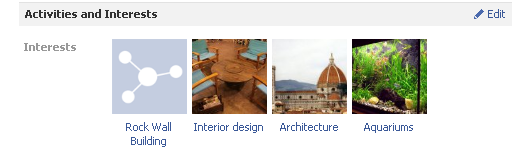
Not a ton of stuff on there, yet telling about me personally. Yes I do like architecture and interior design, and read a ton of blogs on the subject every day. Dig around further in my Facebook page and you will find that I have a 500 gallon salt water aquarium in my house.

Now all of these interests were set up when I set up my profile some years ago - and they haven't changes since. And yet - I have a lot of other interests - I have just never gone back and changed anything in here.

Given the ever more targeted advertising being done with the aid of companies like Raptor Ventures portfolio company Graph Science, I got to thinking: shouldn't there be an easier way to update your interests on the fly from anywhere on the web?

How do I see a site on Virgin Gorda (my favorite Caribbean island) and mark it as an interest so that it becomes easier for Caribbean travel companies to find me?

How do we make it easier to use the social media tools we have to serve us - rather than us serving them?

Sunday
Dec182011

A Nation Of Digital Shopkeepers

Yesterday Fred Wilson had an interesting post up on AVC.com about the Louis CK experiment.

On it, I said the following:

Yeah and that's the real interesting thing about all of this.Guys like Louis CK are going to be able to do this because of their built in audience, hard won over years of work, but they are going to make less than they did in the past - as those middlemen extracted pretty high rents for their services.The unknowns will have the ability to make something - rather than nothing.And the middlemen just get run over.So the high end comes down to the middle, and the low end moves up a but - and everyone in the middle gets pushed out of the system period. Frictionless capitalism = Europe. A vast middle class

Which I realize probably needs a little explaination.

I have long held a theory that the Internet is the great leveler - leveling the playing field for just about everybody - or certainly more people than ever. In Internet 1.0, there were a few firms and people that controlled all the traffic, and thus all the monetization - and that Internet reflected the world around it pretty well - to me it looked just like the U.S. at the time - the big corporations got bigger and controlled more and more.

With Web 2.0 and the rise of the social web, and a higher level of inter connectedness (if that's even a word) we've gone back to being nations of shopkeepers. Don't want to buy from Target, no problem - do your XMAS shopping on ETSY. Don't like what Yahoo music is serving up - no problem - Spotify is giving away 6 months of free music - with some great apps to go along with it.

In short, the Internet has driven us back to a more European model.

We live in a wide variety of small villages and groups (Facebook friends and Google circles) and shop in small marketplaces with  highly specialized and curated selections (Fab.com, Lot 18, Gilt, etc...)

We are a nation of digital shopkeepers.

Only now, we are no longer bound by geography and can live in multiple worlds at the same time.

Also, in the typical European model, due to the social programs, there is a vast middle class who gets by okay. Sure there are still stratas of society and people do move around, but the middle still dominates. Here in the US there is far more stratification and far more mobility but the edges dominate.

The web changes all of this. Margins are consistently compressed driving the high end lower toward the middle, and because of the vast audience you can reach, the very bottom can move up. Those who preyed on the middle - the so called middle men, get squeezed as their traditional command and control function disappears.

Tim Westegren of Pandora used to refer to all of this as an artists middle class - where you were neither struggling to make ends meet nor U2 - but there was a place in the middle where you could produce your art, find an audience, and get by.

We've seen this in music, in crafts (the Etsy's of the world), in book publishing (Wattpad comes to mind), and in other creative pursuits.

It's an interesting phenomenon and certainly worthy of thought and discussion.

Perhaps one of these days, elections in the U.S. and elsewhere will not be framed in light of the traditional issues affecting the physical nation, but the issues affecting the towns we choose to live in and become active in online.

Wednesday
Dec142011

Teamwork - You Never Know

Last night I went to see my beloved NY Rangers hockey club at the newly refurbished Madison Square Garden (Hint for all you New Yorkers out there - get to the Garden, they've done a wonderful job reinventing the place)

While the team came away with an L - getting shut out 1-0 - the game did get me thinking about teamwork.

VC's are always evaluating teams, not just the founder or founders abilities, but we are also making a judgement as to whether or not we feel that the founders are going to be able to field and motivate a great team around them. Very few men (or women) are an island. It does take a village (or a small office cramped with tech gear and red bull) to build a company.

The easy route is to invest where there has been previous success - founders who have built teams around them in the past.

Look at Zynga for instance. Mark Pincus certainly had built companies before, and I suspect that if you went back and asked Fred Wilson or Brad Feld why they backed Mark at Zynga, a lot of the reasoning would be around knowing Mark, and knowing he could pull a great team together around him.

There are lots more examples: Mike McCue at Flipboard, Chris Dixon when he put together Hunch, our partner Doug Camplejohn at his current company Fliptop (where Raptor is an investor), or Linkedin when Reid Hoffman started it.

The harder route is to invest in unproven builders - and yet some of the largest wins have come from exactly these people. Steve Jobs never had a company before Apple, nor did Bill Gates before Microsoft or Mark Zuckerberg before Facebook. I was lucky enough to be involved with Tim Westergren at Pandora - another start-up neophyte.

Most Rangers fans would have written off a large part of this season - yet here we are almost to Christmas - and the Rangers have the fewest losses of any club in the league. Most people can't name the stars on the team - but as a unit they are playing well together and getting the job done effectively.

I recently had dinner in Palo Alto with a team of 6 guys who all worked in one small room. What struck me the most was the level of camraderie among them, built through long hours of work in tight quarters, and their ability to joke and get along with each other. They were a tight unit and I believe they will do great things - even though there is no track record to point to.

Truth is, you never know which team is going to gel to get you to the promised land. There are signs along the way (hard work, great inter personal skills, ability to lead or inspire etc...), but none scream - this is the team: invest here.